
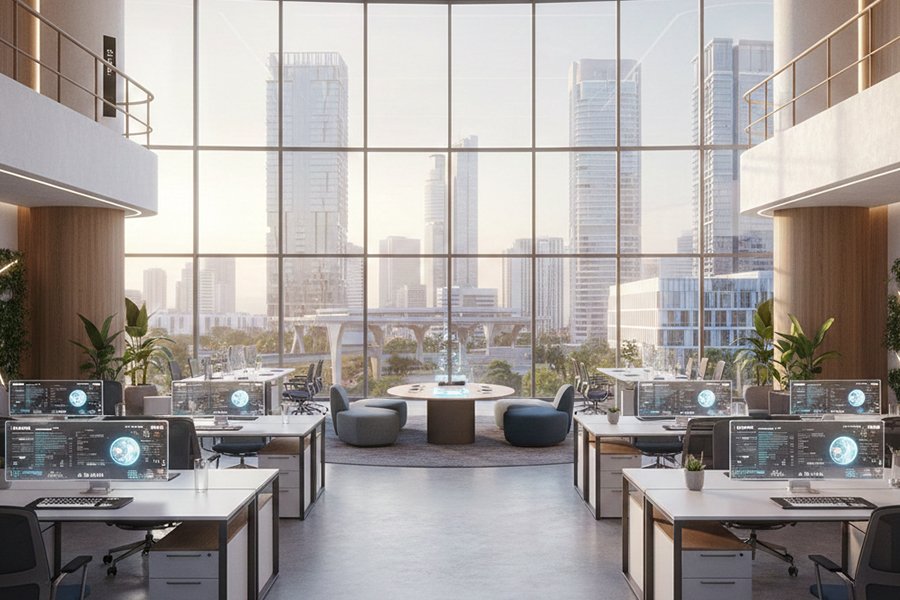
Why Peripheral East Leads Bengaluru’s 2025 Redesign Boom
Bengaluru has always been India’s technology capital, but 2025 pushed the city into an entirely new cycle of growth. The most interesting part. It is not the traditional CBD or Outer Ring Road corporate district that is leading the transformation. It is Bengaluru’s Peripheral East. Once considered a spillover market, the region has now become the epicentre of the city’s next office design wave, backed by more than 20 million square feet of projected absorption and a workforce that expects its environment to match the pace of innovation.
The surge in demand has also redefined what companies want from their workplace partners. Many global technology firms, GCCs, engineering hubs, cloud operations teams, and AI-driven product groups are actively searching for interior designers office Bengaluru who can create spaces that support speed, technical complexity, and cultural identity at the same time. This shift in requirement explains why the demand for the best office interior designers in Bengaluru has grown sharply through the year. Organisations want design that does more than look good. They want design that solves real operational and experiential challenges.
Why Peripheral East Became the Centre of Bengaluru’s Redesign Story
Peripheral East offers something Bengaluru desperately needed. Scale. Connectivity. Young workforce clusters. And the ability to build next generation work ecosystems from scratch. GCCs expanding into India prefer regions where they can grow across multiple buildings or campuses without disrupting operating teams. This area provides exactly that.
Flexible leasing cycles, cleaner land blocks, and modern grade A supply have also attracted companies setting up AI labs, cybersecurity operations, cloud engineering pods, and product development groups. These teams rely on stable infrastructure and spaces designed for deep focus as well as rapid sprint collaboration. Peripheral East gives them the ideal combination of size and freedom.
The design brief for these companies is rarely traditional. They want emotionally intelligent workplaces, multi-mode collaboration zones, smart tech infrastructure, and stronger identity expression. They also want environments that help reduce fatigue and enable high flow work.
The Real Challenge Behind Bengaluru’s Next Office Boom
The biggest challenge in these new office builds and redesigns is not capacity. It is complexity. Large GCC expansions require environments that are predictable, comfortable, and easy to navigate. But they also require acoustic precision, adaptable zoning, and technology that stays invisible yet powerful.
Many organisations underestimated how quickly small acoustic issues can compound in high density tech teams. A minor echo becomes a daily distraction. A poorly isolated meeting pod becomes unusable. A collaboration corner without sound absorption loses its purpose. These elements matter significantly because engineers and design teams depend on quiet flow states.
This is why companies now evaluate design partners on their mastery of technical nuance. The attention to detail is what separates a visually impressive office from a high performing one. It is also why searches for the best office interior designers in Bengaluru increased substantially in 2025. Leadership teams want experts who understand both aesthetics and engineering.
The AIA Three Step Workspace Redesign Framework for GCCs
AIA has refined a three step approach that has become especially effective for large scale redesigns and new builds in Bengaluru’s Peripheral East. The process ensures that design decisions remain strategic and that execution stays predictable, even with fast timelines or complex requirements.
Step One. Decode How Teams Actually Work
The starting point is behavioural insight. Instead of assuming how the organisation functions, AIA maps team rhythms, meeting patterns, collaboration frequency, typical energy curves, and cultural expectations. This helps understand where privacy matters most, where social activity adds value, and where flexibility is essential. It also guides zoning so the space matches how work naturally flows rather than forcing people into unnatural patterns.
Step Two. Design Adaptive Ecosystems, Not Static Layouts
This is where purposeful zoning and modular systems come together. AIA focuses on creating distinct work modes. Deep focus bays that protect concentration. Sprint collaboration pods for high intensity teamwork. Hybrid ready meeting suites designed with acoustic balance. Informal social nodes that spark conversations. Transition zones that help shift mental states without disruption.
The design also accounts for future expansion. Many GCCs in Bengaluru grow rapidly, which means floorplates must evolve without heavy renovation cycles. Modular elements, flexible furniture, and integrated technology make these transitions smoother and faster.
Step Three. Engineer Technical Precision Into Every Layer
This stage often differentiates a good office from a successful one. Acoustics, lighting, thermal comfort, ergonomic calibration, and AV performance shape everyday experience. Even the most beautiful space can feel stressful if it amplifies sound, overheats during peak loads, or creates visual fatigue.
AIA ensures these technical layers stay consistent across every zone. Acoustic seals, baffle systems, sensor based lighting, hybrid friendly AV setups, and future proof wiring make the workspace resilient. This is especially important for Bengaluru’s AI, cybersecurity, and dev-ops teams who require controlled environments for sustained cognitive work.
The Human Side of Bengaluru’s Redesign Wave
Despite the scale of the redesign boom, the real story is human. Teams want environments where they feel grounded, energised, and connected. They want places where collaboration is easy and where quiet work is protected. They want movement through the space to feel natural and not forced. When workspace design respects these needs, performance rises, fatigue drops, and culture strengthens.
This is exactly why more organisations now look for interior designers office Bengaluru who can blend global workspace intelligence with local sensibilities. They want partners who know what makes Bengaluru unique and what global teams expect.
Looking Ahead. Bengaluru’s Next Three Years
Given current momentum, Bengaluru’s Peripheral East will continue to influence workspace evolution across India. As GCCs expand and tech teams demand more thoughtful environments, the search for the best office interior designers in Bengaluru will keep rising. Companies want workplaces that scale with purpose, protect wellbeing, and empower innovation.
The redesign boom is only beginning. What will define the next phase is not square footage but spatial intelligence. And Bengaluru is perfectly positioned to lead that conversation.
