
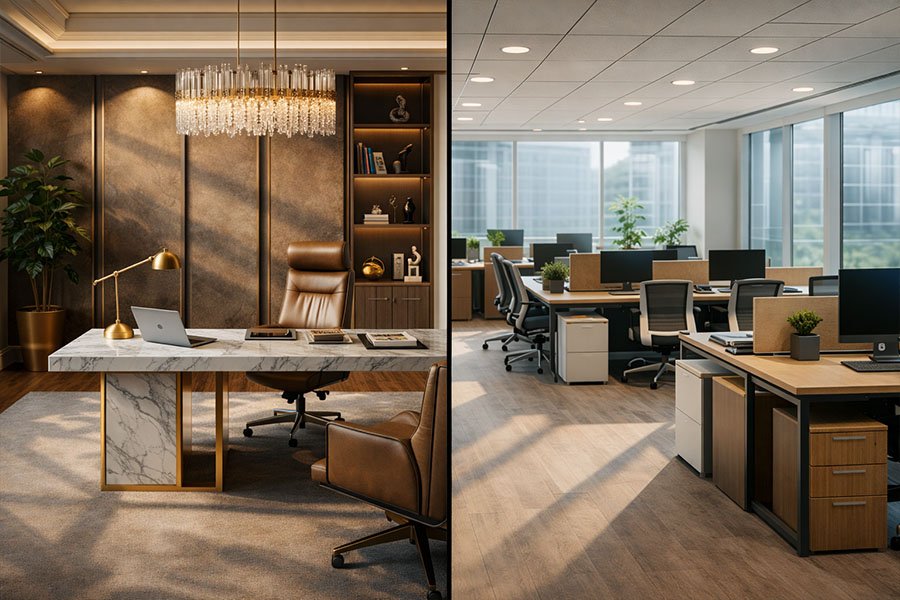
Luxury vs. Functional: What Your Office Actually Needs (AIA Explains)
When planning office design, businesses often frame the decision as luxury versus functional—as if these were opposing choices. Should you invest in premium finishes and impressive aesthetics, or prioritize practical efficiency and cost control?
At AIA, we’ve learned this is the wrong question. The right approach isn’t choosing between luxury and function—it’s understanding what drives genuine business value.
The Luxury Trap
Expensive materials, designer furniture, and Instagram-worthy aesthetics create immediate visual impact. But luxury without strategy often fails:
Misaligned Investment: Marble reception areas impress visitors, but if your business rarely hosts clients, that investment delivers minimal return. Meanwhile, your team struggles with inadequate meeting rooms or poor acoustics.
Superficial Solutions: High-end finishes can’t compensate for flawed layouts, insufficient storage, or technology infrastructure that doesn’t support how you actually work.
Maintenance Burden: Premium materials requiring specialized cleaning or frequent replacement transform initial luxury into ongoing operational cost.
Luxury becomes valuable only when it serves specific business objectives—client impression, talent recruitment, brand positioning—not as decoration for its own sake.
The Functional Limitation
Conversely, purely functional design focused exclusively on cost minimization creates different problems:
Talent Disadvantage: In competitive employment markets like NCR, workspace quality influences recruitment and retention. “Functional but uninspiring” offices struggle attracting top professionals.
False Economy: Cheap furniture fails quickly, poor lighting reduces productivity, inadequate acoustics create frustration—the savings evaporate through operational inefficiency and replacement costs.
Brand Disconnect: Your office communicates organizational values. Purely utilitarian spaces may signal cost-cutting rather than quality, affecting client perceptions and employee pride.
Functionality without appropriate quality becomes expensive through reduced performance and accelerated replacement.
The AIA Approach: Strategic Investment
We help clients invest strategically—allocating budgets where they generate maximum business value:
Client-Facing Zones: Reception areas, conference rooms, and executive spaces receive premium treatment when these directly affect business development and partner impressions.
Performance-Critical Elements: Superior lighting, acoustic engineering, and ergonomic furniture deliver productivity returns justifying higher investment—even in back-office areas.
Durability Over Decoration: Selecting quality materials that perform reliably for years rather than cheaper alternatives requiring frequent replacement or premium finishes serving only aesthetic purposes.
Scalable Systems: Modular furniture and flexible infrastructure enabling growth without reconstruction- functional today, adaptable tomorrow.
Cost Optimization: Value engineering identifies where standard specifications perform equivalently to premium options, redirecting savings toward elements genuinely affecting outcomes.
Making Smart Choices
The question isn’t luxury versus functional—it’s strategic versus arbitrary. Through our integrated fit-out and build and interior outfitting approach, AIA ensures every investment serves clear business objectives.
Premium where it matters. Efficient where it doesn’t. Strategic throughout.
Your workspace should work as intelligently as your capital allocation decisions.
Ready to invest strategically in your NCR office? Connect with AIA to discuss how we optimize budgets for maximum business impact.
