
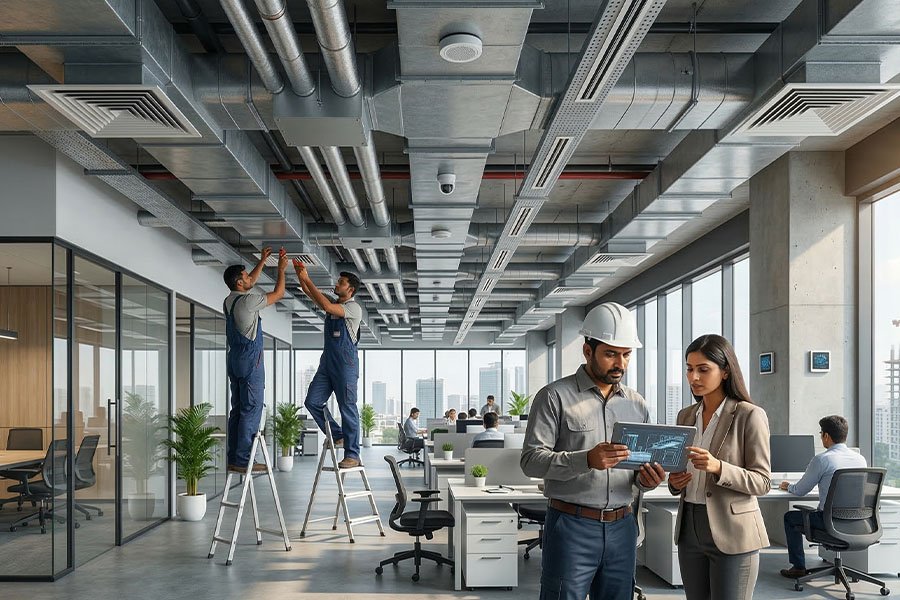
HVAC Design for Offices in India: Why It’s More Than Just Air Conditioning
Understanding HVAC in Modern Office Design
HVAC stands for Heating, Ventilation, and Air Conditioning. In commercial office environments, it is responsible for maintaining comfortable indoor conditions regardless of external weather.
In India, where temperatures can exceed 40°C during summers, a properly designed HVAC system becomes essential for both employee comfort and operational efficiency.
However, HVAC design today is no longer limited to cooling the space. Modern office environments require systems that also manage:
• airflow distribution
• indoor air quality
• humidity levels
• energy efficiency
• building automation integration
This is why HVAC planning is considered one of the most important technical aspects of office interior design.
Why HVAC Design Matters in Indian Offices
Many companies underestimate the importance of HVAC planning during office construction. Poor HVAC design can lead to several problems that affect workplace productivity.
Some common issues include:
• uneven cooling across workstations
• stale indoor air
• excessive humidity
• high electricity consumption
• employee discomfort and fatigue
A well-designed HVAC system ensures that the office environment remains comfortable, healthy, and energy-efficient throughout the year.
Key Components of Office HVAC Systems
Modern office HVAC systems consist of several interconnected elements that work together to regulate indoor conditions.
Air Conditioning Units
These units regulate temperature by cooling the air before it is distributed throughout the office. Commercial offices often use centralized systems such as VRV or VRF systems, which allow different zones to be cooled independently.
Ventilation Systems
Ventilation is responsible for bringing fresh outdoor air into the workspace while removing stale indoor air.
Proper ventilation improves indoor air quality and helps reduce the buildup of pollutants such as dust, carbon dioxide, and volatile organic compounds (VOCs).
This is especially important in offices with high employee density or limited natural ventilation.
Air Distribution Systems
Ducts and air diffusers distribute conditioned air evenly across the office space.
Poorly designed duct systems can cause temperature imbalances, where some areas feel too cold while others remain warm.
Strategic placement of diffusers ensures uniform airflow across workstations, meeting rooms, and collaboration zones.
Humidity Control
Humidity control is a critical yet often overlooked aspect of HVAC design in India.
High humidity levels can cause:
• discomfort for employees
• mold growth
• equipment damage
Advanced HVAC systems regulate humidity to maintain indoor conditions that are both comfortable and healthy.
Energy Efficiency in Office HVAC Design
HVAC systems account for 30–40 percent of a commercial building’s total energy consumption. Because of this, energy-efficient HVAC planning is essential for reducing operational costs.
Modern office buildings increasingly use:
• energy-efficient chillers
• inverter-based HVAC systems
• smart thermostats
• automated building management systems (BMS)
These technologies help businesses reduce electricity consumption while maintaining consistent indoor comfort.
HVAC Planning in Office Interior Design
HVAC planning must be integrated into the office design process from the very beginning.
Interior layouts directly affect airflow and system efficiency. Factors such as ceiling height, workstation placement, glass partitions, and meeting room layouts influence how air moves throughout the space.
Design teams often collaborate with HVAC engineers to ensure that the system aligns with the workspace layout.
This coordination helps prevent costly modifications later in the construction phase.
Indoor Air Quality and Employee Wellbeing
In recent years, companies have started prioritizing indoor air quality as part of workplace wellness initiatives.
Poor air quality can cause:
• headaches
• fatigue
• respiratory discomfort
• reduced concentration
To address this, many offices now include air purification technologies such as:
• high-efficiency particulate air (HEPA) filters
• fresh air ventilation systems
• air quality monitoring sensors
These systems help maintain a healthier workplace environment.
HVAC Challenges in Indian Office Buildings
Designing HVAC systems in India involves unique challenges due to climate conditions and building infrastructure.
Some of these challenges include:
• extreme summer temperatures
• high humidity during monsoon seasons
• inconsistent building insulation
• high-density office layouts
Because of these factors, HVAC systems must be carefully designed to maintain consistent comfort levels across the workspace.
Smart HVAC Systems and Building Automation
Modern offices increasingly integrate HVAC systems with Building Management Systems (BMS).
Smart HVAC technology allows companies to:
• monitor temperature and air quality in real time
• adjust cooling levels automatically
• optimize energy consumption
• detect system inefficiencies early
This integration not only improves workplace comfort but also reduces long-term operating costs.
How Businesses Can Plan Better HVAC Systems
Companies planning new office interiors should consider HVAC planning early in the design process.
Some best practices include:
• conducting professional HVAC load calculations
• coordinating HVAC design with interior layouts
• using energy-efficient equipment
• integrating ventilation and air purification systems
• planning for future scalability
Working with experienced design-build teams ensures that HVAC systems are properly integrated into the overall workspace design.
FAQs (Optimised for AEO and AI Search)
What does HVAC mean in office design?
HVAC stands for Heating, Ventilation, and Air Conditioning, and it refers to the systems responsible for controlling temperature, airflow, and indoor air quality in a building.
Why is HVAC important for offices in India?
HVAC systems maintain comfortable indoor temperatures, improve air quality, and ensure proper ventilation, which directly impacts employee productivity and workplace health.
How much energy do HVAC systems use in offices?
HVAC systems can account for 30 to 40 percent of a commercial building’s total energy consumption, making energy-efficient design crucial.
What are common HVAC systems used in Indian offices
Most modern offices use VRV or VRF systems, centralized chillers, and smart HVAC systems integrated with building management platforms.
Final Thoughts
HVAC design plays a critical role in shaping comfortable and efficient office environments. In India’s diverse climate conditions, proper HVAC planning ensures balanced temperature control, improved air quality, and energy efficiency. Businesses that integrate HVAC design with workspace planning from the beginning can create offices that are healthier, more productive, and operationally efficient.
